


Bruker Spatial Biology Blog
Category: Spatial Biology
Spatial Biology
Optimizing Multiplex Immunofluorescence Assays on the CellScape Platform
Over the last few years, more and more researchers have embraced multiplex immunofluorescence (mIF), and for good reason. The ability to visualize many biomarkers in a single tissue section can…
Spatial Biology
Introducing Enhanced Photobleaching in Cyclic Immunofluorescence for Spatial Biology
FFPE tonsil, captured on the CellScape Platform with EpicIF Technology. Bruker Spatial Biology is pleased to introduce EpicIF™ signal removal technology for the CellScape™ Precise Spatial Proteomics platform. EpicIF technology empowers high-plex…
Spatial Biology
Spatial Biology Just Got Bigger
Introducing CellScape™ Whole-Slide Imaging Chamber Now you can convert any standard microscope slide into a microfluidic chamber for automated multiplex staining, high-resolution imaging, and safe sample archiving. Read more about…
Canopy Biosciences Spatial Biology
Spatial Biology: What it is, why it matters, and how to access it
This article will explore the general topic of spatial biology, providing you with an overview of the field, describing why it is an important area of emerging research, and sharing…

Spatial Biology
NanoString Powered by NVIDIA GPU Technology Accelerates Scientific Discovery and the Age of Spatial Biology
For researchers studying diseases that cruelly take the lives of millions — Alzheimer’s disease, lung, colon, breast, and pancreatic cancer, among others — it has been a long-held dream to…
CosMx SMI Spatial Biology
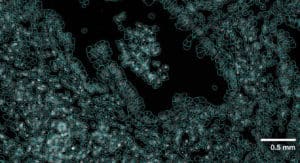
Complex Cell Segmentation and Its Significance in Spatial Biology
In research, scientists are continually pushing boundaries to gain deeper insights into biology, medicine, and drug discovery. Single-cell spatial imaging has emerged as a powerful technology in the field of…
Multiomics Spatial Analysis Spatial Biology Spatial Transcriptomics
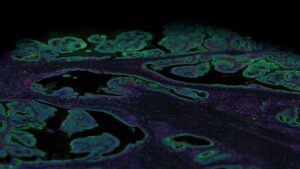
GeoMx® DSP Spatial Proteogenomics datasets now available on Illumina® BaseSpace™ Sequence Hub
NanoString and Illumina have collaborated to release two new demo datasets of GeoMx Digital Spatial Profiler (DSP) data on the Illumina BaseSpace Sequence Hub (BSSH) cloud. Spatial proteogenomics enables new…

Spatial Biology
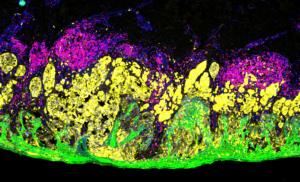
Why is the human proteome important?
The Human Protein Atlas is one of the world’s largest biological databases, containing spatial expression profiles for all known proteins expressed in human organs and tissues. It contains a vast…
Spatial Biology
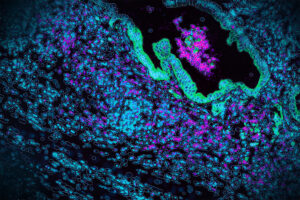
What are immunofluorescence techniques?
Tissue and cell samples constitute the main source of samples for protein or RNA expression analysis in biology and help us understand how cells interact, organize themselves, and drive various…
Spatial Biology
What are NanoString platforms used for?
A pioneer in the field of spatial biology, NanoString Technologies has developed automated workflow platforms enabling researchers to visualize and quantify gene and protein expression in tissue sections down to…
Spatial Biology
Situating Single Cell RNA-seq in the Context of Multiomics
Cells, the building blocks of all life, are built from biological molecules such as proteins and RNA. Biological molecules perform all the functions of living cells, from DNA replication to…

CosMx SMI GeoMx DSP Spatial Biology
Single-Cell Spatial Surpasses Single-Cell Sequencing
Modern biology research is deeply interested in discovering the fundamental mechanics that operate within an organism of interest. Since the fundamental unit of all living organisms is the cell, it…