Webinar Recap: MicroRNA Profiling for Psychiatric Disease Biomarker Research
In this article:
Summary:
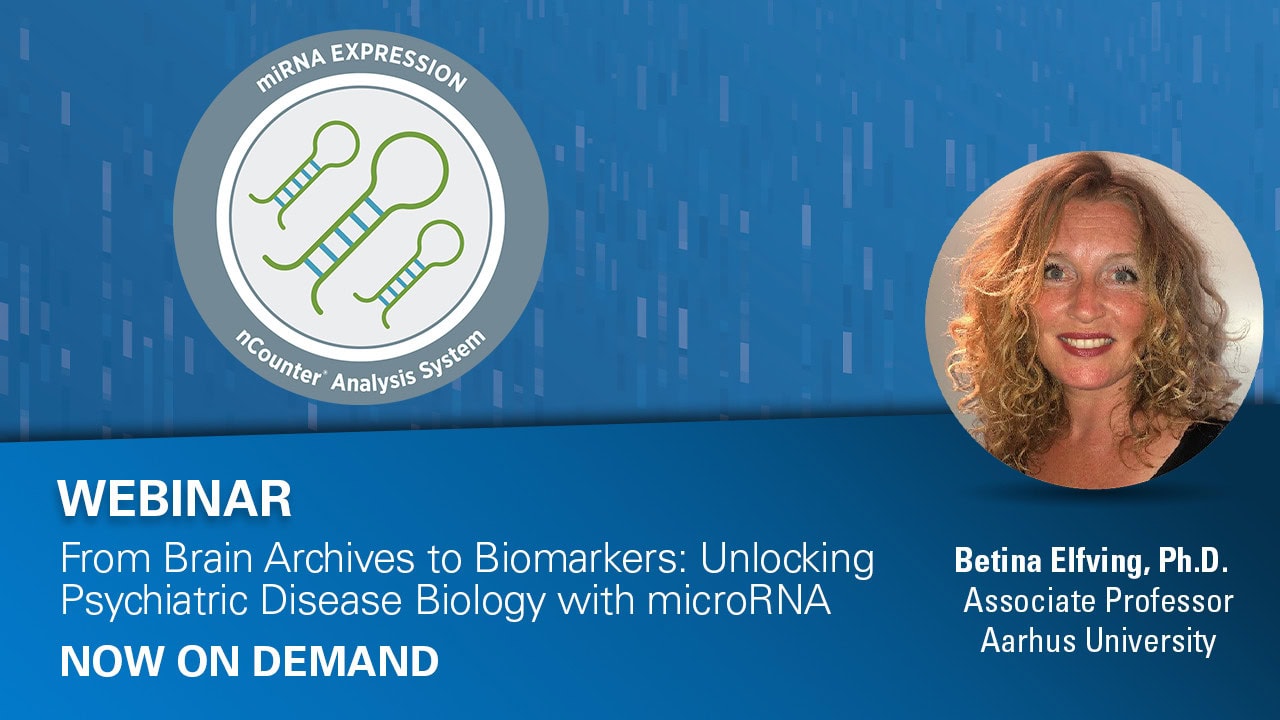
MicroRNAs can preserve useful biological information in challenging samples, including formalin-fixed paraffin-embedded brain tissue stored for decades. In this webinar, Betina Elfving, Ph.D., and Ana Ortalli, Ph.D., discuss how researchers used the nCounter® Analysis System to profile miRNA in psychiatric brain archives, translational models, and blood, then prioritized candidates for deeper study.
Psychiatric conditions are clinically complex, and their symptoms can overlap. Researchers therefore continue to look for molecular measurements that can complement symptom-based assessment and help clarify disease biology. One promising area is microRNA profiling, which measures short, non-coding RNAs that regulate gene expression after transcription.
The webinar “From Brain Archives to Biomarkers: Unlocking Psychiatric Disease Biology with MicroRNA” brings that opportunity into focus. Dr. Elfving shared results from human archival brain tissue, a pig model, and an adolescent depression cohort. Dr. Ortalli explained how direct hybridization with the nCounter Analysis System can support targeted miRNA analysis and broader multiomic research. Together, their presentations offered a practical view of what is possible, what still needs validation, and what researchers should consider before starting a study.
- Archived FFPE brain tissue can retain measurable miRNA even when longer RNA signals are compromised.
- In Dr. Elfving’s specific archival study, the nCounter Analysis System produced useful miRNA data, while the team’s sequencing attempt was not successful.
- MicroRNA profiles revealed differences by psychiatric diagnosis, sex, brain region, and experimental time point.
- Broad profiling helped the team select a smaller set of candidates for in situ hybridization and functional follow-up.
- Sample history, extraction method, input amount, and normalization strategy materially affect study design and interpretation.
Key takeaways
1. Why microRNAs matter in psychiatric disease research
A microRNA, or miRNA, is a short non-coding RNA molecule, typically about 22 nucleotides long, that can regulate gene expression by binding to messenger RNA. One miRNA may influence many genes, while one gene may be regulated by several miRNAs. This network-level role makes miRNAs relevant to research on complex conditions where multiple pathways may contribute to disease biology.
Dr. Elfving’s group at Aarhus University focuses on experimental and molecular psychiatry, with particular interest in depression, biomarker identification, and treatment research. She noted that psychiatric diagnoses are based largely on symptom profiles and that symptoms can overlap across disorders. Molecular biomarkers are not replacements for clinical assessment, but they may become useful research tools for investigating underlying biology and developing more precise hypotheses.
Sex differences are another important part of that picture. Dr. Elfving emphasized that depression prevalence, symptoms, and treatment response can differ by sex, yet many mechanistic questions remain unresolved. Her team therefore designed studies that could examine both disorder-related and sex-related miRNA patterns.
2. A rare brain archive created a unique research opportunity
The Danish brain collection discussed in the webinar includes nearly 10,000 brains collected from patients who died at state mental hospitals between 1945 and 1982. The archive also contains histological slides and FFPE blocks. These materials are scientifically valuable, but their age and storage history create substantial analytical challenges.
Formalin-fixed paraffin-embedded tissue is preserved by formalin fixation and embedding in paraffin wax. This supports long-term storage and tissue morphology, but nucleic acids can become fragmented or chemically modified. For researchers working with irreplaceable historical samples, a central question is whether enough molecular signal remains to support credible analysis.
Dr. Elfving’s team first optimized extraction from the old blocks. They reported measurable miRNA from samples stored for as long as 67 years and sufficient concentrations for downstream analysis. In subsequent work on the nCounter Analysis System, mRNA housekeeping signals showed degradation and variability, while average miRNA expression remained more aligned across samples. The team detected 171 miRNAs in prefrontal cortex and 313 in hippocampus in the study described.
3. Why the nCounter Analysis System worked well for Dr. Elfving’s samples when sequencing did not
This comparison is best understood as a researcher’s experience with a specific sample collection, not as a universal ranking of technologies. Dr. Elfving initially considered sequencing as she expanded the work. After obtaining useful miRNA results with the nCounter Analysis System, her team also attempted sequencing on the archival material. She reported that the sequencing effort was not successful and that the experience reinforced the team’s decision to use the nCounter Analysis System for this project.
Several aspects of the workflow were important in her study:
- Targeted direct detection fit the biological question. The team wanted to quantify a defined set of miRNAs and compare patterns across samples and brain regions.
- The archived material was challenging. The blocks had been stored for decades, and longer RNA signals were degraded. Small miRNAs remained measurable in the team’s workflow.
- The results could guide follow-up efficiently. Broad miRNA profiling helped the researchers narrow a large candidate set to a smaller group for in situ hybridization and functional testing.
- The group could conduct analysis internally. Dr. Elfving highlighted that students and postdoctoral researchers in her laboratory could work with the data without the level of external biostatistical support her team typically needed for sequencing.
The nCounter Analysis System provides rapid and robust targeted RNA and multiomic expression proven for translational through clinical studies. The platform uses direct hybridization and supports profiling and analysis of RNA, protein, and miRNA with user-friendly protocols. In this webinar, the practical value of the nCounter Analysis System was clearest in the context of difficult bulk samples and a targeted biomarker discovery workflow.
The takeaway is not that sequencing lacks value. Sequencing and targeted expression profiling answer different questions and have different samples, analysis, and discovery considerations. For Dr. Elfving’s decades-old FFPE brain samples, the nCounter Analysis System generated interpretable miRNA measurements while her group’s sequencing attempt did not. That direct experience is what made the nCounter Analysis System a strong fit for her study.
4. Profiling revealed patterns across disorders, sexes, and brain regions
The archival study included samples associated with schizophrenia, bipolar disorder, and depression, as well as prefrontal cortex and hippocampus tissue. Initial work showed differences by disorder, sex, and brain region, while the later nCounter analysis expanded the number of miRNAs the team could examine and provided a basis for selecting candidates for further study.
One candidate was miR-9. The group observed sex-related differences involving miR-9, including patterns within depression, then collaborated on functional testing in rodents. Blocking miR-9 was associated with depression-like behavior in the experimental test described during the webinar. The team also began exploring radiolabeled anti-miR-9 for imaging, although Dr. Elfving was careful to describe those observations as early work still being prepared for publication.
This progression illustrates a useful discovery strategy: profile a broad but defined set of molecules, identify reproducible candidates, localize them in tissue, and test selected candidates in functional models. Each step reduces the candidate space while adding biological context.
5. The approach extended to translational models and blood
Pig brain miRNA after psilocybin exposure
Dr. Elfving also described a study designed to establish an nCounter miRNA workflow in pig brain tissue. Researchers used a human miRNA panel after filtering for miRNAs with complete sequence identity between humans and pigs. They detected 79 miRNAs in the prefrontal cortex and 49 in the hippocampus.
The largest number of changes appeared one day after the psilocybin administration, with fewer changes at day seven. The pattern also differed by brain region and time point. miR-212 and miR-107 showed robust acute regulation in the prefrontal cortex across four normalization approaches. The findings support continued investigation of region-specific and time-dependent miRNA responses, but they do not establish clinical effects or therapeutic mechanisms.
Blood-based research in adolescent depression
A separate study examined blood from female adolescents with major depression and matched healthy controls. The team observed the downregulation of three miRNAs, and of these miR-1253 and miR-1246 remained downregulated across four normalization strategies. Predicted targets pointed toward inflammatory biology, which motivated complementary measurement of inflammatory markers.
Two markers, PDGF-BB and IL-7, were increased in the depression group compared with controls in the study presented. These results are exploratory and require validation in larger and more representative cohorts. They nevertheless show how targeted miRNA measurement can be paired with protein analysis to examine multiple biological layers rather than interpreting one analyte in isolation.
6. Practical lessons for challenging miRNA studies
The webinar included several recommendations grounded in the team’s own laboratory experience.
Document sample history: Collection, fixation, handling, and storage can all influence molecular quality. Even when historical details are incomplete, researchers should record everything that is known.
Test extraction methods: Dr. Elfving advised comparing extraction kits because yield and the number of measurable miRNAs can vary. FFPE tissue may require a method designed for fixed material.
Remove exposed material from old blocks: For the archival blocks, the team cut roughly 10 micrometers from the exposed surface before extraction. Dr. Elfving suggested that material deeper in the block may be better protected.
Optimize input for the sample type: In the brain tissue workflow presented, approximately 30 ng/µL worked well. Lower inputs produced insufficient signals in the team’s tests. This is a study-specific observation, not a universal loading rule.
Compare normalization strategies: The group looked for overlap across several normalization approaches. Signals that remained consistent across methods were treated as stronger candidates for follow-up.
Match the method to the question: The choice between targeted profiling, sequencing, and other methods should reflect sample quality, desired breadth, analysis resources, and the need for downstream validation.
Best practices and key learnings
Can decades-old FFPE brain tissue be used for microRNA profiling?
Yes, in the study presented. Dr. Elfving’s team measured miRNAs in FFPE brain blocks stored for up to 67 years. Performance depended on extraction, sample preparation, input, and quality assessment. Researchers should validate workflows for their own tissue type, preservation history, and study goals.
Why did the nCounter Analysis System work well for Dr. Elfving’s project compared with sequencing?
Her team obtained useful, targeted miRNA measurements from highly aged FFPE material using the nCounter Analysis System. Their subsequent sequencing attempt on the archival samples was not successful. Dr. Elfving also valued the ability to analyze the nCounter data within her group. This reflects her study conditions and should not be generalized to every sample or application.
Were healthy controls included in the archival human brain study?
No. The historical collection consisted of samples from psychiatric patients, and the team concluded that adding controls from a different collection with different storage history would introduce comparability issues. The study focused on differences among disorders. A newer fresh-frozen brain study includes control subjects.
How did the researchers address diagnostic heterogeneity?
The historical diagnoses were reassessed using later diagnostic frameworks. The team also analyzed data in blinded and unblinded ways. Dr. Elfving reported that about 80 percent of cases grouped in a way that aligned with diagnosis, with fuller details planned for a future publication.
What comes next for psychiatric miRNA biomarker research?
Next steps include validating prioritized miRNAs in additional cohorts, examining localization with in situ methods, conducting functional studies, and integrating miRNA with other biological measurements. The goal is to move carefully from exploratory signatures toward reproducible mechanisms and potential translational relevance.
How can Bruker Spatial Biology help guide your method selection?
The nCounter Analysis System worked well for this laboratory and this archival collection, while the team’s sequencing attempt did not. That result does not settle the choice for every study. It does show why sample condition, desired content, available analysis support, and validation plans should guide method selection.
Book a call to discuss if the nCounter Analysis System is the right solution for your research.
Go from archived samples to focused hypothoses
Discover how rapid and robust targeted gene expression with the nCounter Analysis System can help transform challenging samples into actionable biomarker hypotheses, from translational research through clinical studies.